A presentation by Bill Moorhead, Consulting Field Botanist
Presented at CIPWG Symposium, 2016
Background
In 2002, the Farmington River Watershed Association (FRWA), under then-director Kevin Case, conducts the Farmington Valley Biodiversity Project, and inventory of plants, animals, and ecological communities of conservation concern in 7 towns within the Farmington River watershed. A meta occurrence of approximately 200 acres of intact High Floodplain Forest are identified along the “flatwater” stretch of the river. This type of floodplain forest, occupying well-drained soils, hosts 5 State-listed rare plants, several uncommon/restricted plants, and multiple animals of conservation concern (e.g., American Woodcock).
Background
Invasive plants are identified as the most serious threat to the High Floodplain Forest communities. Some occurrences are lightly infested, while others are already dominated in the understory by invasives such as Japanese Barberry (Berberis thunbergii) and Winged Euonymus (Euonymus alatus).
In 2005, FRWA and the National Park Service (NPS) Lower Farmington River and Salmon Brook Wild & Scenic Study Committee organize a volunteer invasive removal effort by Avon Old Farms School boys on their yearly spring community service day. The site is one of the highest quality intact High Floodplain Forest occurrences, at Fisher Meadows Recreation Area just NW of the Old Farms Road bridge. The objective is removal of Garlic Mustard (Alliaria petiolata) and Dame’s Rocket (Hesperis matronalis) before they become more abundant.
Background
In 2006, FRWA and the Wild & Scenic Committee attempts to repeat the 2005 effort with AOF boys on their service day, but bad weather and recent flooding make an attack on the herbaceous invasives impossible, resulting instead in a limited effort to pull Barberry and other invasive woody plants in the same area. The AOF boys are only available on that date, so rescheduling for a rain date is not an option.
In 2007, on the AOF service day, another flood makes the same area completely inaccessible, and the effort is redirected to the current treatment area because it is one of the few areas above water. Herbaceous invasives are not significant, but Barberry occurs in profusion, so it becomes the object of our attack. Thus begins this longitudinal experiment, by accident of timing of the AOF service day and a large flood on the Farmington River.
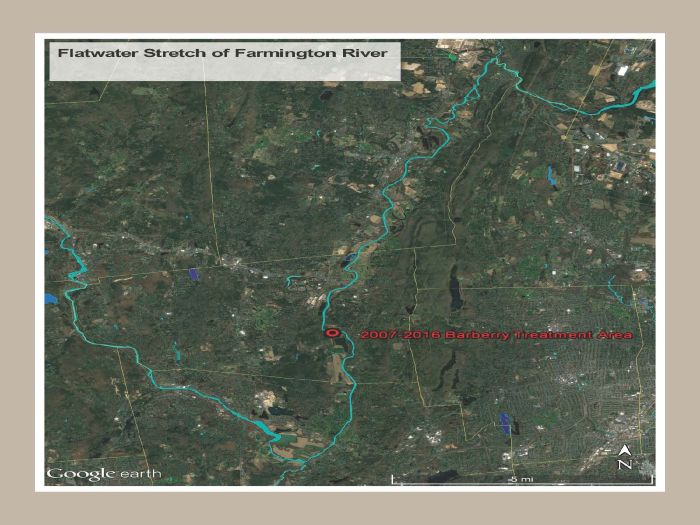
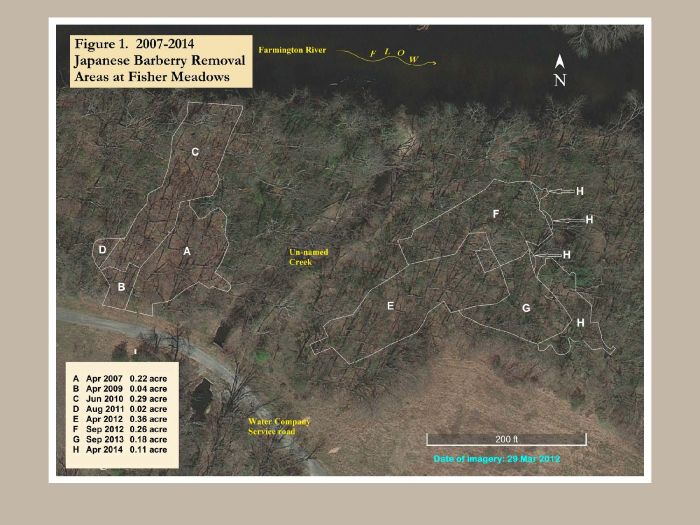
Habitat Characteristics of Treatment Areas
Soils are predominantly well-drained Occum silt loam “capped” with 70 to 90 cm of loamy sand. Soil pH is in 5.4-5.8 range.
The most important canopy trees are Red Oak, Black Oak, White Ash, Shagbark Hickory, Bitternut Hickory, American Basswood, Red Maple, Silver Maple, and Black Birch.
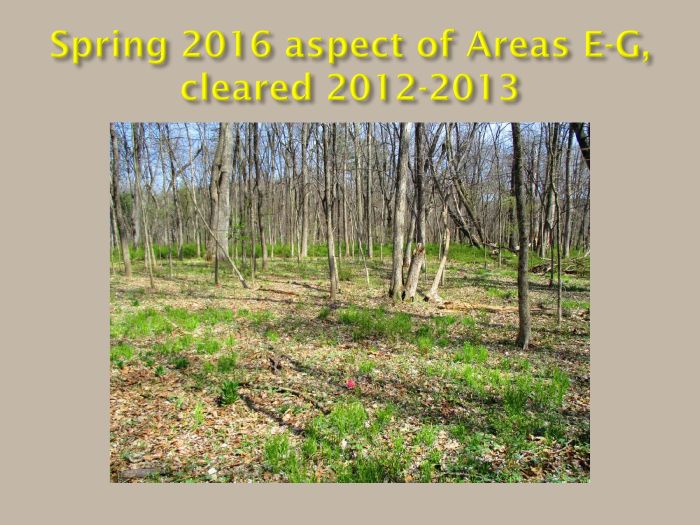
Herb layer comprised of at least 82 native species when not heavily suppress by Barberry or Winged Euonymus, dominated by sedges (Carex spp.) and (in April and May) spring ephemerals.
Shrub layer is very open to sparse when invasive shrubs have been removed.
Primary Questions
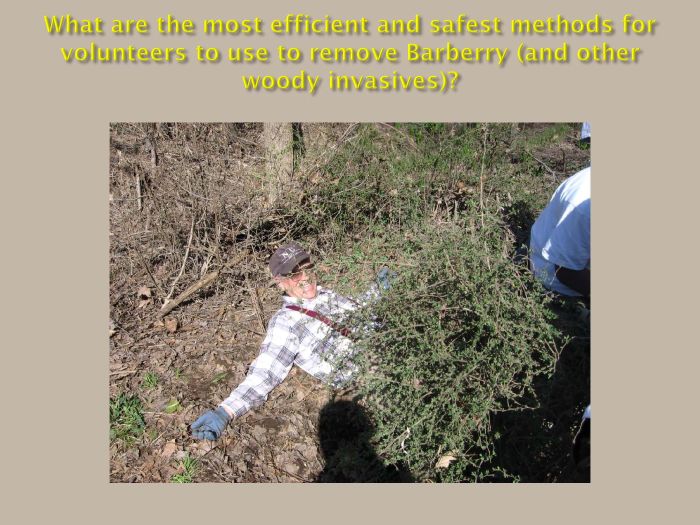
What are the most efficient and safest methods for volunteers to use to remove Barberry (and other woody invasives)?
How will the understory and herb layer develop after Barberry removal?
Will native species or invasive species colonize the cleared areas faster?
What is the minimum number of person-hours (and other resources) required to restore and maintain a
native-dominated floodplain forest understory and herb layer?
Methods Tried and Discarded
- Weed wrench
- Lassoing Barberry with rope and pulling with up to 12 people, tug-o-war style
- Lassoing Barberry with rope and pulling with auto
- Team pulling without tools (6-8 pullers required for large plant)
- Single worker chopping roots thru soil with machete, and pulling when enough roots are cut so that plant can be pulled by single worker
- Cut, allow to resprout, and torch
Final Method of Choice
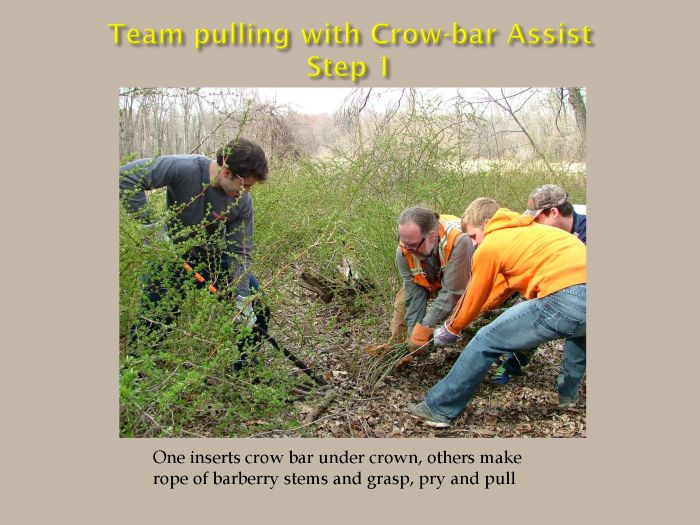
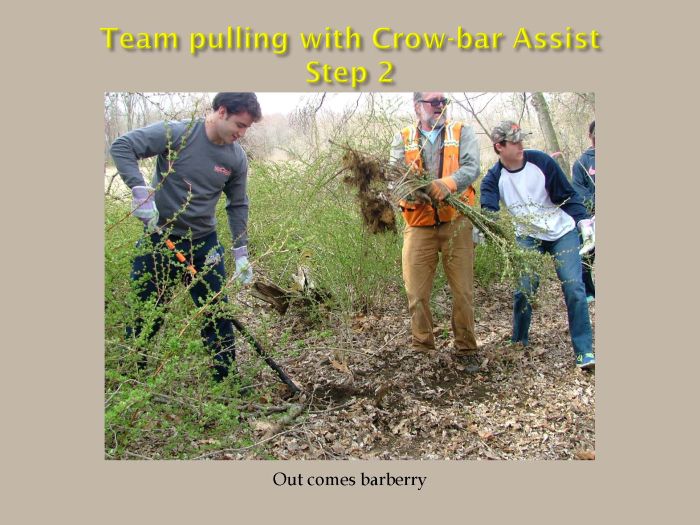
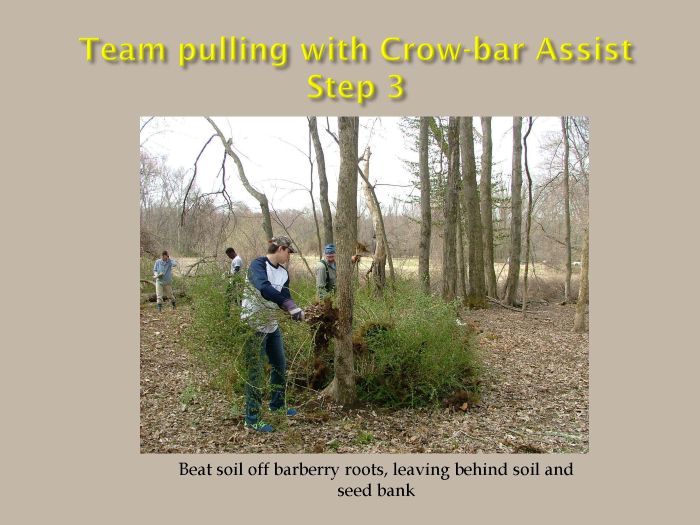
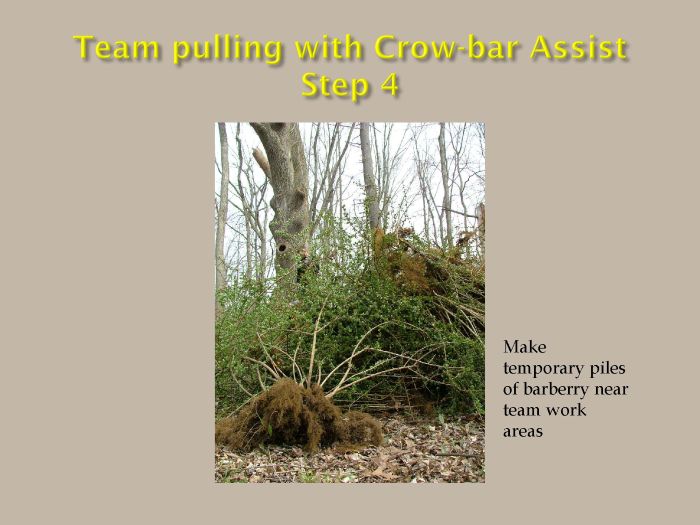
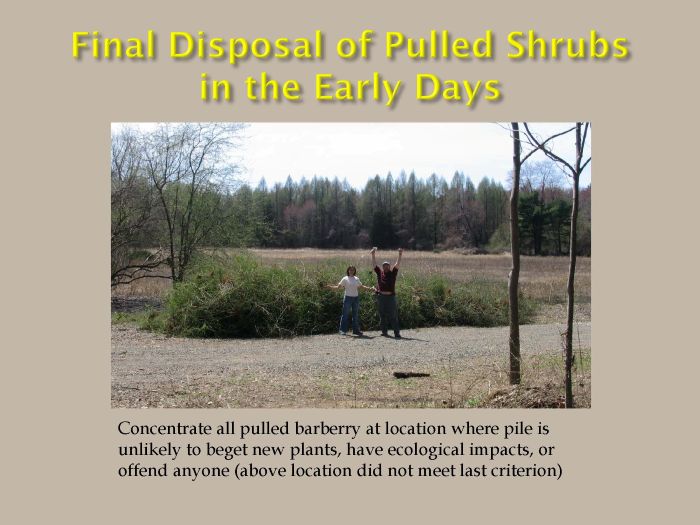
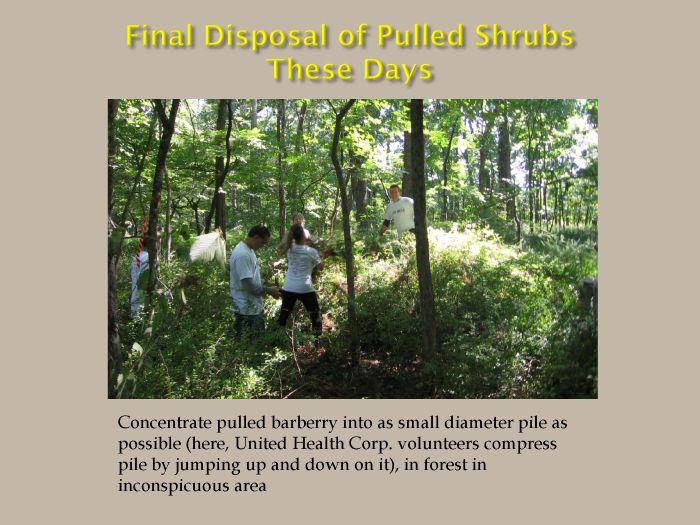
Team pulling with crow-bar assist (1 crow-bar person and 3-4 pullers)


Safety Hazards
- Ticks
- Thorns
- Poison Ivy
- Tools
- Trips, falls
- Potential back injury and other muscle injury
Data Collection & Monitoring
2007-2016:
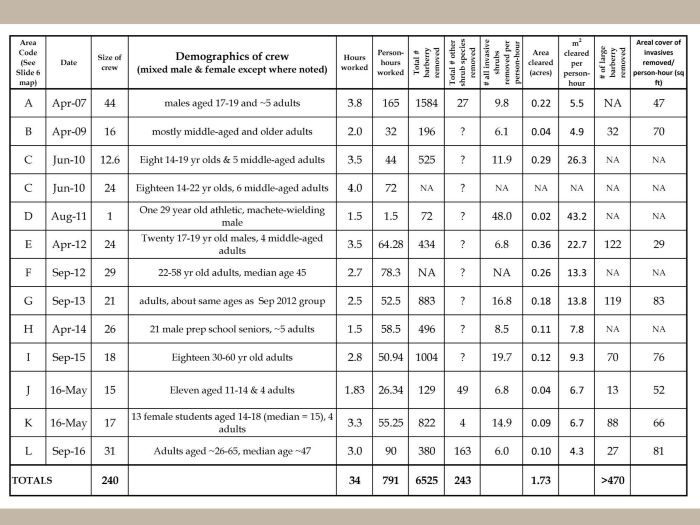
- demographic data on volunteers
- hours worked
- counts of Barberry and other shrubs pulled (counts stratified by shrub size most years)
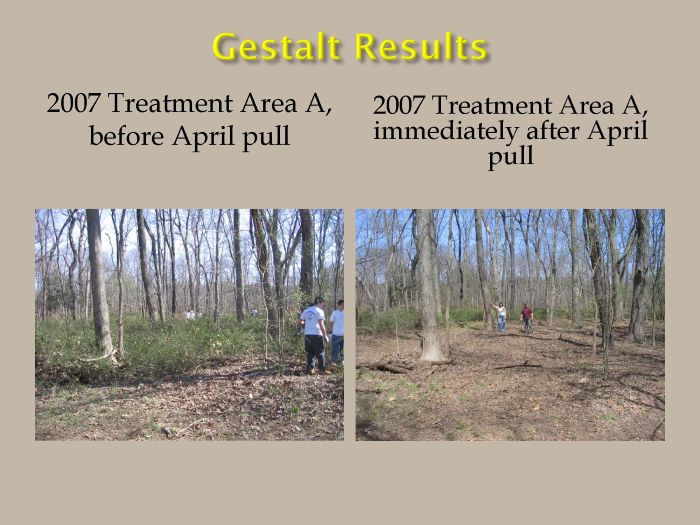
- landscape photos from permanent photo points
- subjective assessments of vegetation development
2015: begin to establish, sample, and photograph permanent total floristic 1-sq-m plots
2016: complete establishment and sampling of 329 total floristic 1-sq-m plots in all areas treated through summer 2016
2015-2016: Garlic mustard 2nd year plants counted as pulled before dispersing seeds, in Areas E-H
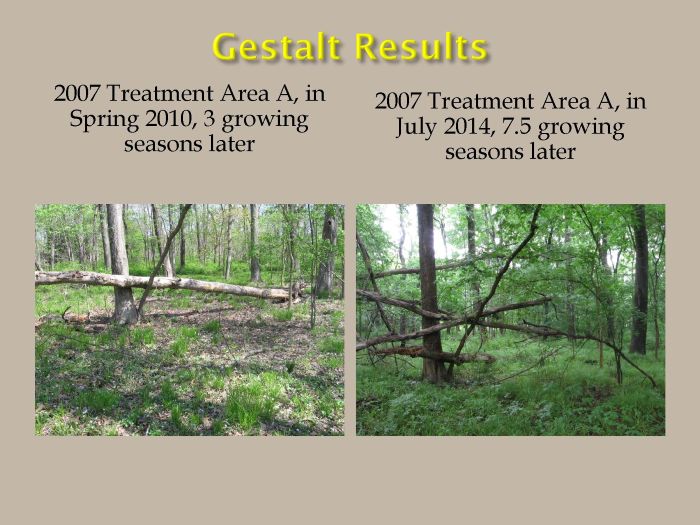
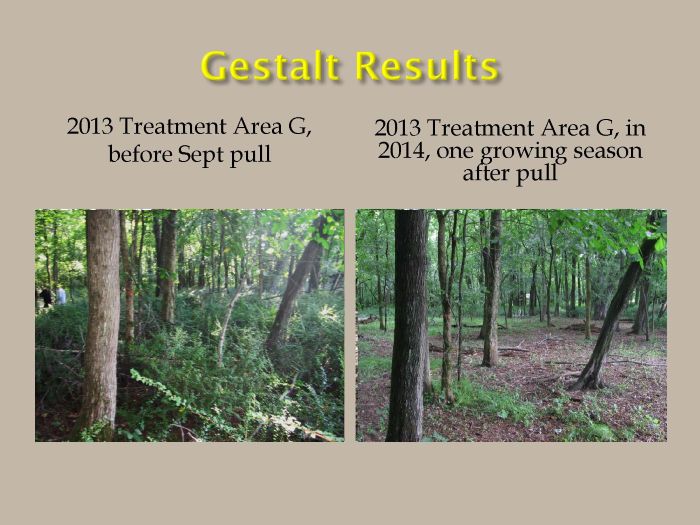
Post-treatment Behavior of Herbaceous Vegetation
- Ground remains sparsely vegetated for first 2 growing seasons after removal of dense Barberry
- Notable increase in native herbaceous cover occurs by 3rd growing season after of Barberry removal, achieving high areal cover values by ~5th growing season, which is maintained thereafter. Among the most prominent herbaceous species are Spring Beauty (Claytonia virginica), Dutchman’s Breeches (Dicentra cucullaria), Sprengel’s Sedge (Carex sprengelii), Bromelike Sedge (Carex bromoides), and several species of violets (Viola spp.). Herbaceous assemblage includes 82 native and 16 non-native species, the latter category including 10 invasive species.
- Garlic Mustard (Alliaria petiolata) and Japanese Stiltgrass (Microstegium vimineum) are only invasive species that notably increased after treatment. In Areas A-D (2007-2011), neither have achieved prominence comparable to native species and seem to be stable in low abundance. Both continue to increase in Areas E-H. Three years of control of Garlic Mustard may have caused it to be declining (200, 6000, 4000 2nd year plants counted/pulled in 2014, 2015, and 2016, respectively). Microstegium remains well subordinate to the native species in importance, with no control efforts, but it may be increasing (monitoring plot data will tell).
- State-Threatened Davis’s Sedge Carex davisii has increased from perhaps 100 plants prior to Barberry removal to at least several thousand in all treatment areas, cumulatively. State-Special Concern Virginia Waterleaf (Hydrophyllum virginianum) has increased also, albeit much less dramatically
Post-treatment Behavior of Woody Vegetation
Woody invasives (mainly Japanese Barberry, Winged Euonymus, Oriental Bittersweet, and Climbing Euonymus) are ubiquitous as very small plants in the herb layer, with relatively small areal cover values compared with native herbaceous species.
Barberry is gradually expanding from plants that were not pulled and some fragments of roots not pulled, but the vast majority of seedlings appear not to be recruiting.
Native woody plants are present in the herb layer as seedlings and plants a few years old, but very little recruitment to the shrub layer is occurring (Bitternut Hickory, American Elm, Red Maple, and Boxelder are among the most frequent in the herb layer). This may be the natural state of this forest type, based on observations elsewhere on the Farmington River floodplain (as opposed to a condition imposed by an unnaturally high deer population). Of 38 woody species in the herb and shrub layers, there are 28 native and 10 nonnative species, the latter category including 8 invasive species.
Conclusions
- The “team-pulling with crow-bar assist” method is a safe and effective way to remove infestations of Barberry, at least in sandy stone-free soils. Upon volunteers’ first introduction to method, removal rates of up to 19.7 shrubs/person-hour have been achieved. In this ecological setting, areal rates of clearing of 4.3 to 26 sq m (46 -283 ft2)/person-hour have been achieved. This method is usable by volunteers aged ~13 to ~60+.
- In this ecological setting, a large number of native herbaceous species will aggressively colonize sites cleared of Barberry infestations, achieving high areal cover within 5 years.
- In this ecological setting, Garlic Mustard and Japanese Stiltgrass are likely to invade cleared areas but may or may not continue to increase to problem levels, for reasons not yet understood.
- Volunteers with little previous experience, from various backgrounds, can be motivated and quickly trained, and will brave thorns, ticks, and poison ivy to do a good job.
- Competition seems to be a very effective motivation, and thus it is important to take the time to conscientiously measure productivity, which allows different work crews to be scored
People That Made It Happen and Helped 2005-2016
- Eric Hammerling, former Executive Director of FRWA, current Executive Director of CT Forest and Parks Association
- Eileen Fielding, current Executive Director of FRWA
- Aimee Petras, Outreach and Education Coordinator of FRWA
- Alisa Philips-Griggs, Water Quality and Projects Coordinator of FRWA
- Joyce Kennedy Raymes, former NPS Lower Farmington & Salmon Brook Study Wild & Scenic Study Coordinator
- Sally Rieger, chairperson, Lower Farmington & Salmon Brook Study Wild & Scenic Study Committee
- Bill Moorhead, Consulting Field Botanist
- Directors and staff of Town of Avon Recreation and Parks and Public Works Departments
- Nels Barrett, Michael Margo, and Jacob Isleib, Ecologists and Soil Scientist, respectively, with USDA-NRCS
- Ed Faison, Senior Forest Ecologist, Highstead Arboretum
- Ca. 240 volunteer students and adults
Volunteer Groups
Avon Old Farms School
The Hartford
United Health Corporation
Heads Up! Hartford
Westover School
Farmington Valley Academy Montessori School
Free radical volunteers: Glenn Rivard, Harry Spring, Cynthia Griggs (79 at time of pull), Philip Griggs (77 at time of pull), and several other masked men and women whose names we didn’t catch.