Year-round Invasive Control using Basal Bark/Triclopyr Ester applied with sponge dabber and small sprayer
TriTown Forest Preserve is comprised of 545 acres bordering North Stonington, Griswold and Preston. Abutting TriTown to the northwest, 800 acres are protected by a conservation easement held by The Nature Conservancy. The southeastern 409 acres of TriTown was purchased in 2018 from proceeds of a CT DEEP OSWA grant, foundations, generous donors, etc.
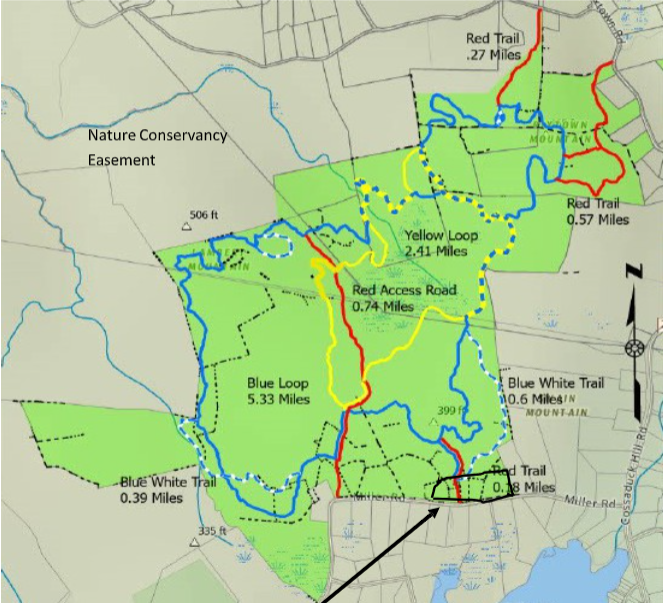
Thanks to volunteer efforts from the time of the 2018 acquisition, by the fall of 2022 invasives were under control except for 6 acres. While that area had also been stewarded before, extensive tree mortality over the past two years resulted in optimal sunny growing conditions for invasives. The area’s work requirement exploded and required more efficient methods.
From Buckthorn to Barberry, Bittersweet and Beyond
Buckthorn was a new invasive for us and largely confined to the 6-acre site, tagged “The Heart of Darkness”. We found that the PennState website had extensive educational materials on how to manage buckthorn, as well as other invasives, including use of basal oil plus triclopyr ester for non-wetland areas. The biggest surprise was that they said basal oil application was effective throughout the winter. https://extension.psu.edu/buckthorn for much more information.
We wondered if the herbicide mix of basal oil/triclopyr would be equally effective when applied to other invasives. In the fall of 2022, we experimented with dabbing it on multiflora rose, Japanese and common barberry and bittersweet as well as buckthorn.
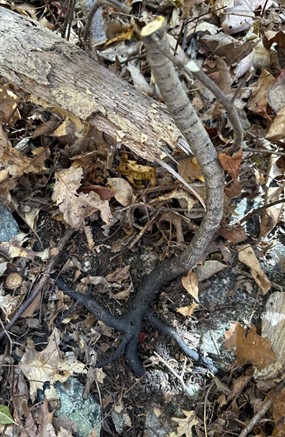
In March, 2023, we saw that the basal oil/triclopyr ester had worked! The large barberry, multiflora and bittersweet were dead, hooray!
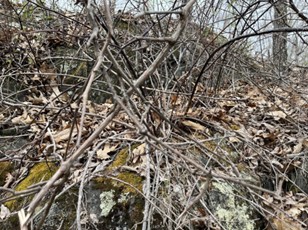
Dead multiflora after treatment using a sponge – the mosses were not impacted.
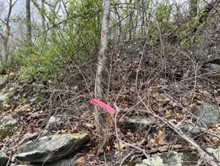
Common barberry dead after treatment. Multiflora behind wasn’t treated.
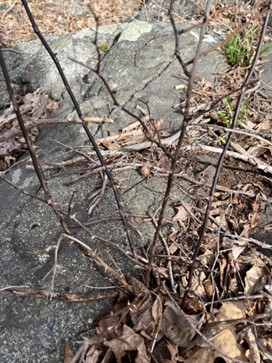
Bittersweet (on mid left side) and multiflora dead after treatment.
In fall, 2023, the intense work began
The 6-acre area was very difficult to walk through due to large multiflora and bittersweet vines and often rocky steep terrain. Smaller multiflora was everywhere and often required identification by looking for the leaf fringe next to the stem to make sure it wasn’t a native rose.
First large tunnels were cut from the road access into invasive areas using a battery powered hedge trimmer. This tool is very effective for dense multiflora and helps keep thorns away. Safety glasses and sturdy clothing are highly recommended.
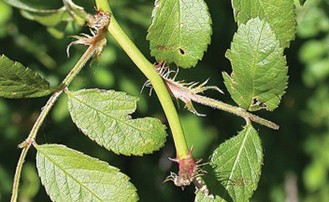
Multiflora rose “fringe” at base of leaves.
Large multiflora branches were cut and stacked away from the immediate work area. Remaining multiflora shoots were cut at waist height, so as to lessen risk from the thorns. We sponged basal oil/triclopyr on the lower 8 inches of each stem and pushed the sponge into the middle of the base of each rose to make sure the exposed base/root structure was covered. We were using blue dye to keep track but found it faded and so cut stems to 8 inches so as to know each had been treated. What a reward to return some weeks later and find the treatment worked!
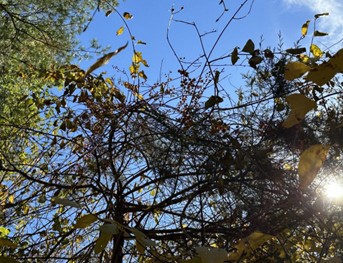
Buckthorn, barberry, autumn olive and winged Euonymus from shrub to tree size were found throughout, many draped with bittersweet. As it was now October, many mature invasive plants in the 6-acre area had flowered and their fruits were ripe or almost so. Many other seeds had already dropped.
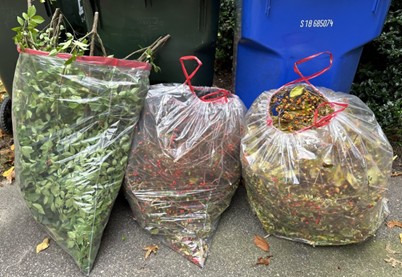
The value of eliminating as much of the seed bank is well known in invasive management. From October 12 to November 15, 2023, invasive seeds were removed, filling a total of eight 50-gallon garbage bags and many smaller containers.
Winter 2023 to Present
Invasives were hit primarily with basal oil/triclopyr ester using a sponge dabber. With such a daunting project, volunteers could choose the area or invasive they wished to work on as there was plenty to go around. We knew the treatment had been effective on sample species, but this much larger, diverse area should be a great test. Fortunately, it worked very well, and our work was worthwhile!
We found the benefits from using a sponge dabber with basal oil/triclopyr ester were many:
• Little physical effort – minimal bending down unless hand clearing debris from the plant’s base. No backpack sprayer required
• No spray drift when using a sponge dabber so wind was also less of a potential issue
• Keeps you farther away from thorns
• Little herbicide needed – only dabbed the bottom 8 inches or so of the stem, or more for
larger plants
• Effective control of small diameter stems up to 6-inch diameter trees
• Kills invasives rooted deep into rock unlike cut and paint which often does not work
• Expands invasive treatment seasons throughout the year when there are potentially fewer bugs, heat and humidity. Gives the steward more schedule options as to treatment plan
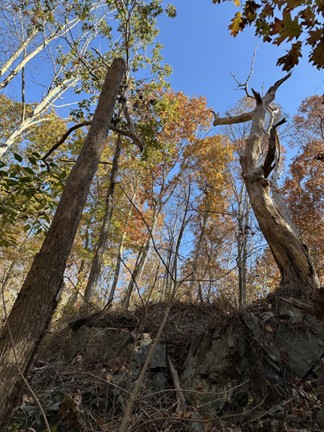
No volunteer wanted to work on this steep scree area with 5 feet high poison ivy shoots pointing up everywhere. It was the last area treated so as to also avoid reptiles living on the west facing cliff!
We concluded that Pathfinder II is worth the extra cost for its pre-mixed convenience, especially given we were using so little herbicide. It also has a minimal odor versus the strong smell of basal oil
+ triclopyr ester, which means its sponge dabber must be covered when not in use. We did not use Garlon 4 Ultra mixed 1:4 in basal oil, as described in the PennState site, but it is another option—please see their website. This terrain was flattish but hardly inviting
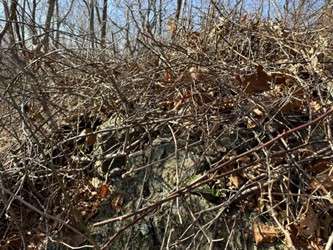
The Reward
The varied understory of oak, pignut and shagbark hickory, sassafras and red cedar saplings, sedges, royal fern, ebony spleenwort, round-leaved pyrola, striped wintergreen, maple leaf viburnum, high bush and low bush blueberry, mosses and lichens now could enjoy much a improved habitat. With continued invasive management, saplings should have the right conditions to grow into the forest canopy. We are restoring the small red cedar forest and adding pitch pines.
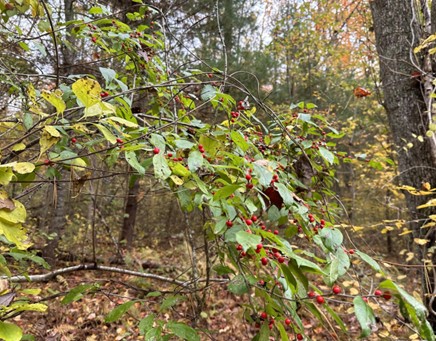
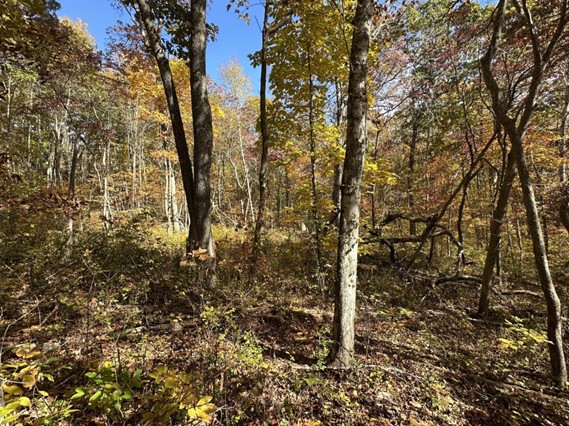
Another surprise was that you could now see through the forest as tall buckthorn, multiflora and winged euonymus were gone. There is much more work to be done, but on a much smaller scale and now in a lovely forest.
Addendum
Thanks to the many volunteers at Avalonia’s TriTown Forest Preserve who made this possible, much appreciated! We are very proud of what we have accomplished and welcome you to come and see this and our other projects to control invasives and to improve habitats.
Thanks also to Avalonia’s Stewardship Director for generously organizing the supply of triclopyr ester and especially for recommending and supplying Pathfinder II.
This is our first draft trying to describe a complex project so if you have any questions or sug-
gestions regarding the project description and summary, please feel free to email me at
suesutherland32@gmail.com. Your feedback will help us to update and no doubt improve this document so that it can be a better tool for invasive management.
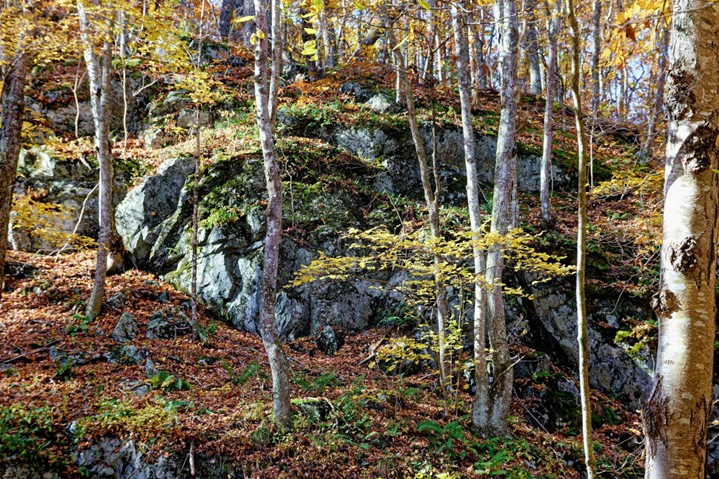
Photo of TriTown’s Lambert Mountain East by Carl Tjerandsen, TrailBoss and Volunteer
Equipment Used
A Chapin 2 gallon or similar sprayer with sponge dabber attached over the spray head works very well. Having the spray hose in a taller sprayer made it easier to reach each invasive without bending down. 1/3 gallon of herbicide was put in the sprayer, and it lasted for months.
Note: You can see when the herbicide mix has covered a stem or base of each invasive as it changes the color of the bark, or you can see a shiny surface. You can also add a suitable blue dye. I keep the sponge dabber in- side at the bottom of the bucket.
Using a 5-gallon orange bucket helps improve stability and it’s easier to see in the forest. The loppers can also fit inside. Fiskars PowerGear 18-inch Loppers are an effective tool but there are many other choices.
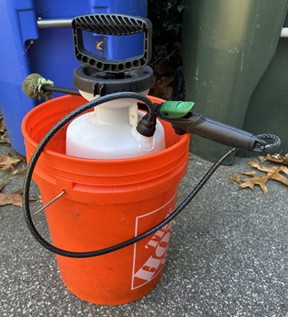
We’ve found it’s useful to also carry a sprayer (without a sponge dabber attached) like the Chapin 1 gallon. We put Pathfinder II in it for spraying multiple branches or lightly hitting the exposed root base of invasives such as those growing into rocks.
6 mil nitrile disposable gloves under Wells Lamont nitrile work gloves offered good protection. In winter, red fleece mittens over the disposable gloves worked well.
Safety glasses and a N95 mask are always handy in case the situation calls for it as is a heavy-duty bag for invasive seeds.
A small rake like the Corona ComfortGEL 7-Tine Extended Reach Rake can be used to clean leaves and other debris away from the base of each invasive saves bending down. Any plants leaning into the treatment area were protected by gently pushing them out of the way until swiping was done.
Buckthorn Blaster—is a small container with a spongy head that can be filled with an herbicide and the yellow cap then secured. I also carry pruning shears and nitrile gloves in the blue case so when I see an invasive in the woods, I can treat it immediately. It is available through Amazon and there may be similar containers from other sources.
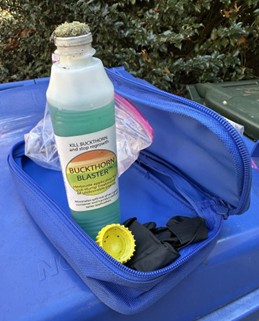
Buckthorn Blaster with basal oil + triclopyr ester
How to make a sponge dabber
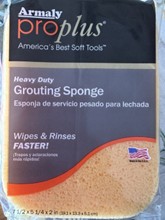
Take a grout sponge and, using a bread knife, cut a 1/2-inch-wide slice across the narrowest part, like you are slicing bread. Cut it so it is about 2 1/2 x 2 1/2-inch square and 1/2 inch thick.
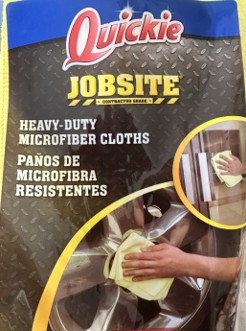
Cut a 6 x 6-inch square of heavy-duty microfiber cloth. Place the sponge’s square side in the middle of the cut cloth as on the left.
Make sure the sprayer head is set to about half open so it can allow the herbicide to flow through. Put the end of the sprayer head where herbicide is released in the middle of the sponge.
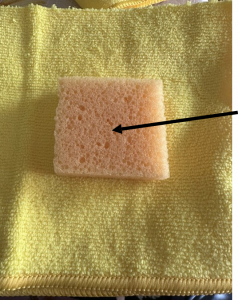
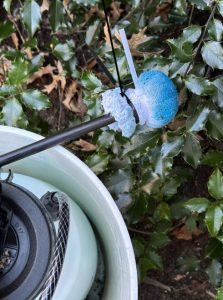
Gently gather the cloth up and around the sprayer head so it covers the sponge and leaves enough material to go over the entire sprayer head.
Wrap a 11-inch nylon zip tie around the cloth wrapped sponge closest to the wand but not
including any of the sprayer. Note in the picture that there are two zip ties. The first white one is too far towards the sprayer tip; the second black one is perfect and should not be cut shorter. If you find that the sponge dabber eventually spins around the wand, you can use masking tape to secure the zip tie end to the wand.
Trim any excess microfiber cloth, leaving at least 1/2 inch in case you need to tighten the tie.
Press the sprayer herbicide control lever on the wand until you can see herbicide in the microfiber layer. Test it on an invasive and press again if needed until you have a sufficiently moist sponge dabber to easily apply herbicide.
The sponge dabber holds quite a bit of herbicide without dripping, enough for many applications. It can easily be stored next to the sprayer when not dabbing.
This system has proven to be very easy to use and effective. Often you can’t help but pick up some dirt but it doesn’t seem to affect the sponge dabber’s performance.